Myth Busting
From Airport Scanners to Broken Bones: 8 X-Ray Myths Worth Leaving Behind
• • 5 min read
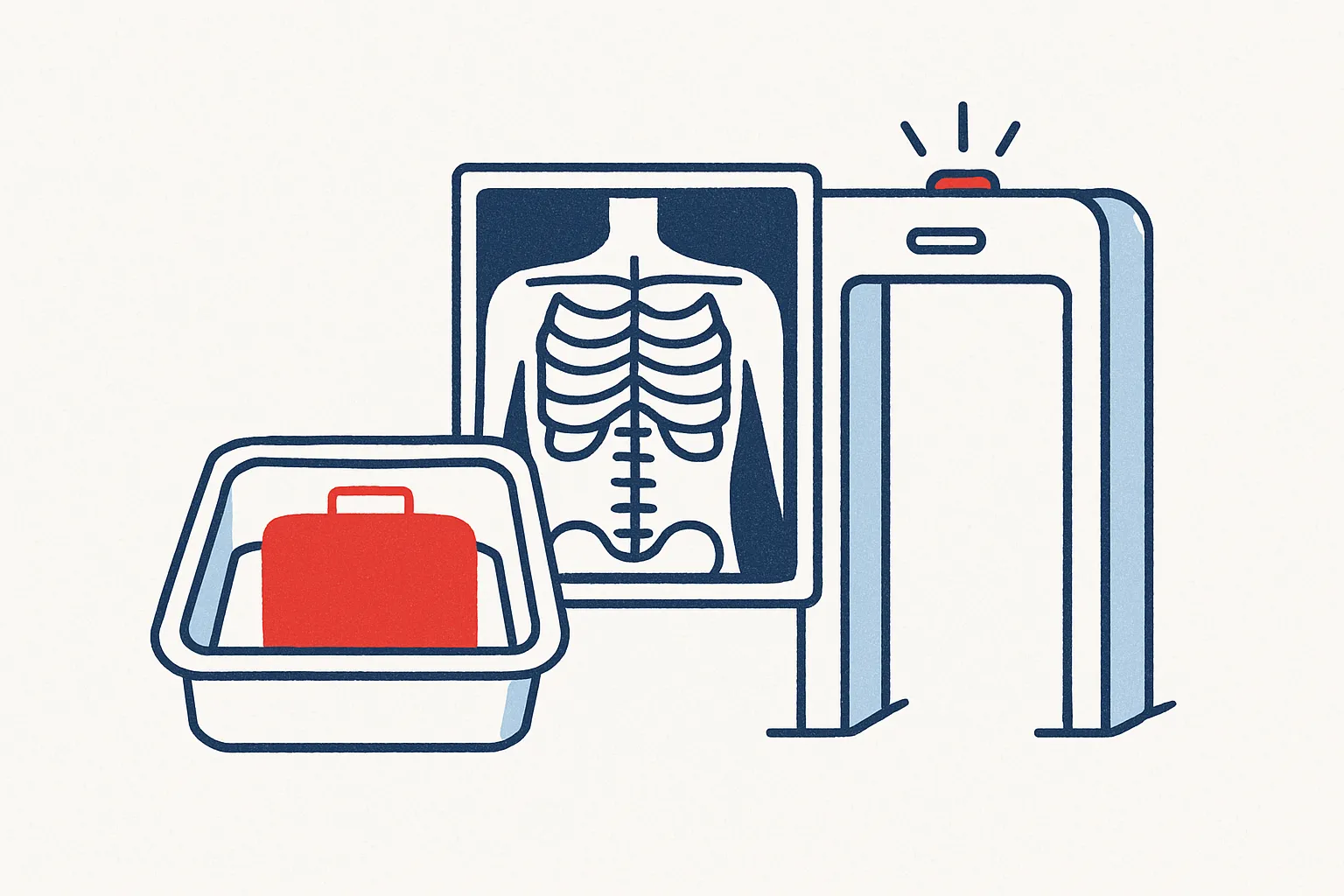
A plainspoken guide to airport screening, flight radiation, pregnancy concerns, and what medical X-rays can and cannot reveal.
No, walking through a metal detector does not give you an X-ray, and a medical X-ray does not leave radiation inside you. In the United States, airport body scanners generally use non-ionizing millimeter waves, while baggage scanners and medical X-rays use controlled amounts of ionizing radiation. The details matter, especially during pregnancy, frequent flying, or an injury that still hurts despite a normal image.
Ionizing radiation has enough energy to affect atoms in the body. That sounds dramatic, but dose and purpose matter. Medical imaging teams use carefully selected settings so clinicians can get useful information while limiting exposure.
The body scanners currently used at most United States airport checkpoints rely on millimeter waves, not X-rays. Millimeter waves are a form of non-ionizing energy, similar to the category used by cell phones and Wi-Fi, although the technology and power levels are different.
These scanners look for objects concealed beneath clothing. They do not create the same kind of internal image as a medical X-ray.
Equipment can vary by country and location. If you have a health concern or an implanted device, tell the security officer and follow the device manufacturer's guidance.
A walk-through metal detector uses a low-level electromagnetic field to notice metal. It does not use ionizing radiation and does not take a picture of your body.
The detector may complain about a belt buckle, keys, or an impressive collection of pocket change, but it is not delivering an X-ray dose. Handheld security wands work on a similar principle.
People with pacemakers or other implanted electronic devices should follow instructions from their clinician and the device manufacturer. Security staff can also explain available screening options.
Carry-on and checked baggage scanners do use X-rays, but scanned objects do not hold onto that radiation. Your clothes, snacks, toiletries, and suitcase will not become radioactive. No superpowers for the luggage, unfortunately.
One notable exception involves undeveloped photographic film. Repeated scanning, especially by stronger checked-baggage equipment, can fog some film. Travelers carrying film can ask airport staff whether a hand inspection is available.
This distinction is useful: being exposed to X-rays is not the same as becoming a source of radiation.
For most travelers, the flight itself involves more ionizing radiation than the security checkpoint. Cosmic radiation comes naturally from space, and less of the atmosphere is above you at cruising altitude to block it.
Exposure varies with altitude, route, flight length, and solar activity. For someone who flies occasionally, the amount is generally considered low. Flight crews and very frequent travelers receive more over time because they spend many hours at altitude.
People who are pregnant or who travel extensively for work can discuss their individual exposure with a clinician or occupational health professional. A security metal detector is not the main concern in that calculation.
Medical X-rays do involve ionizing radiation, so the risk is not zero. However, standard diagnostic X-rays usually use a relatively small dose, and the amount depends on the body part and number of images needed.
A clinician should order an X-ray when the expected information is useful enough to justify the exposure. Imaging staff also adjust equipment for the body area, patient size, and clinical question. Children generally need different settings from adults.
A CT scan also uses X-rays, but it creates many detailed images and usually involves more radiation than a standard X-ray. MRI and ultrasound do not use ionizing radiation. Each test answers different questions, so more detail does not automatically mean a test is the right choice.
You may also notice that lead shielding is not used for every modern X-ray. Guidance has changed because a shield can sometimes cover important anatomy or interfere with the equipment's exposure controls. Practices vary, and the imaging team can explain what applies to a particular exam.
A standard medical X-ray sends a brief beam through the body to create an image. Once the equipment stops, the exposure stops. You do not become radioactive, and you do not expose family members or coworkers afterward.
This is different from certain specialized tests that use a radioactive tracer. Those are not standard X-ray exams and come with their own instructions.
Pregnancy is an important consideration, but it does not create an automatic ban on every X-ray. The body area, stage of pregnancy, amount of radiation, and urgency of the medical question all matter.
An X-ray of an arm or ankle does not expose the uterus in the same way as imaging near the abdomen or pelvis. The clinical team may adjust the exam, select another type of imaging, or proceed when the expected benefit outweighs the risk.
Tell the clinician and imaging staff if you are pregnant or could be pregnant before an exam. They can review the safest reasonable option for your situation. Do not delay urgent evaluation solely because you are worried an X-ray might be suggested.
X-rays are excellent for many bone injuries, certain chest concerns, and some foreign objects. They are not all-seeing.
Small or early fractures may not appear clearly on the first image. Tendons, ligaments, muscles, and other soft tissues often require a physical examination or a different imaging method. Some conditions simply do not show up well on an X-ray.
A normal result should be interpreted alongside symptoms and the clinician's examination. If pain, swelling, movement problems, or other symptoms persist or worsen, seek another medical evaluation. A follow-up exam or different test may be appropriate.
Urgent care can be a practical starting point for many suspected sprains, minor fractures, and other non-life-threatening concerns. A clinician can examine the injury and decide whether an X-ray may help. You can review HMC's medical and imaging services before visiting.
Call 911 or go to the ER for emergency symptoms, including severe trouble breathing, loss of consciousness, uncontrolled bleeding, a bone coming through the skin, or sudden weakness or numbness. When you are unsure where to go, a clinician can help you choose the appropriate level of care.
No appointment is needed. Just walk in to HMC Urgent Care in Dearborn for an evaluation and, when clinically appropriate, an X-ray. Check our location and hours before heading over. Patients with and without insurance are welcome.
This article is for general education and is not medical advice. For personal medical concerns, see a clinician.